Main Categories | Basis Weight | Effective Width | Pattern | Features | Application |
Mono/ Bico PLA | 20-120g | 2100mm | Flat Bond/ Point Bond | Eco Friendly | Food Packaging |
PLA/ Viscose | 20-120g | 2100mm | Flat Bond/ Point Bond | Eco Friendly | Food Packaging |
PBS/ PLA | 20-120g | 2100mm | Flat Bond/ Point Bond | Eco Friendly | Food Packaging |
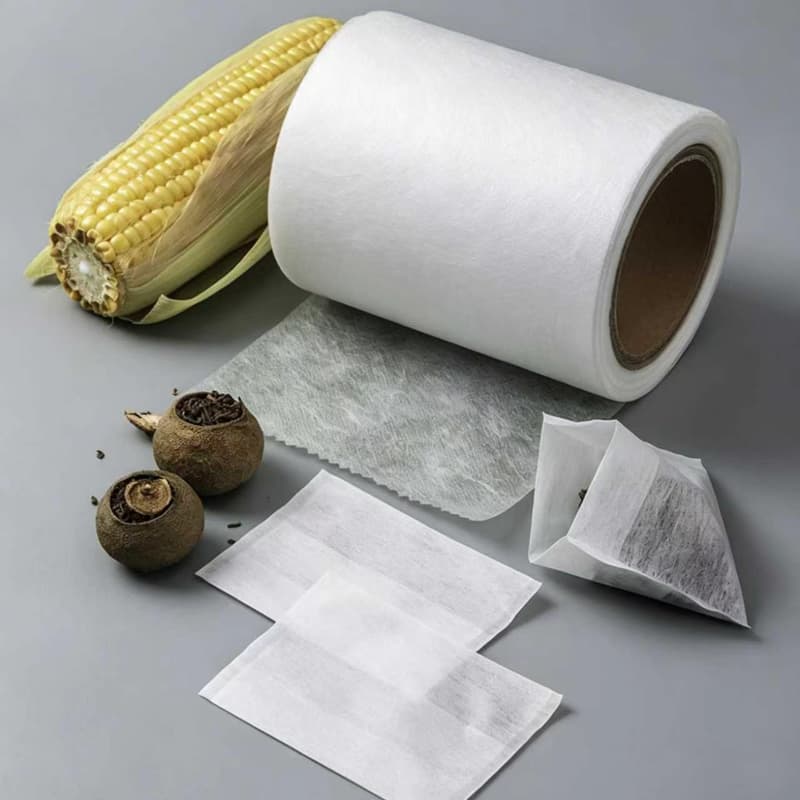
In today's world, where sustainable development has become a global consensus, Biodegradable Nonwoven Fabric has emerged as an ideal alternative to traditional PP (Polypropylene) nonwoven fabrics.
Biodegradable nonwoven fabric refers to a new type of material processed using bio-based or biodegradable polymers (such as PLA, etc.) through nonwoven processes like spunbond, meltblown, and hot air. After its useful life, under specific environmental conditions, it can be acted upon by naturally occurring microorganisms and ultimately decompose completely into natural substances such as carbon dioxide, water, and biomass, returning to the natural ecological cycle.
Depending on the required degradation environment and conditions, biodegradable nonwoven fabrics are mainly divided into two categories: Industrially Compostable and Home Compostable.
Core Features
After its useful life, the material can be completely broken down by microorganisms in a specific environment, leaving no toxic residues or microplastics, significantly reducing the environmental burden.
Based on product design and certification standards, biodegradable nonwoven fabrics can meet the requirements of industrial composting or the more stringent demands of home composting.
Most biodegradable nonwoven fabrics are derived from renewable biomass resources, such as corn starch, sugarcane, and cellulose, reducing dependence on petroleum resources and helping to lower the carbon footprint.
Through formulation and process adjustments, it is possible to achieve softness, breathability, tensile strength, and barrier properties comparable to traditional nonwovens while ensuring biodegradability.
High-quality biodegradable nonwoven fabrics and their degradation products contain no heavy metals or harmful substances, making them suitable for food contact and direct skin contact products.
Key Advantages
Compared to traditional PP nonwovens which can persist for hundreds of years, biodegradable nonwovens can rapidly convert into harmless substances in a suitable composting environment, effectively reducing soil and water microplastic pollution.
After disposal, they can enter organic waste treatment systems and be transformed through composting into nutrient-rich fertilizer, used to improve soil and nourish plants, achieving a true resource closed-loop.
Against the backdrop of increasingly strict global plastic bans and restrictions, using biodegradable nonwoven fabrics is a direct way to meet environmental regulations (e.g., in the EU) and circumvent plastic taxes.
Main Application Areas
Food Service & Packaging: Tea bags, coffee filter bags
Agriculture & Horticulture: Biodegradable nursery bags
The material, thickness and basis Weight can be customized to meet diverse application needs.
For more details, please feel free to contact us.
Email: sales@hlbnonwoven.com